Safety and Occupational Health

Goal and Performance Highlights


Supporting the SDGs
Stakeholders Directly Impacted

Commitment and Target
Safety and occupational health are essential foundations of quality, safe, and continuous healthcare services. This is particularly important in the hospital business, which operates 24 hours a day and brings together multiple groups of people in the same environment, including doctors, nurses, medical personnel, support staff, contractors, suppliers, patients, service users, and visitors.
Sikarin Public Company Limited is committed to creating safe working and service environments that support employee well-being and reduce risks that may affect personnel, service users, and relevant stakeholders. Safety and occupational health are therefore embedded into the Company’s management system, risk management, and healthcare service quality improvement.
Challenges and Opportunities
Sikarin Public Company Limited places great importance on Occupational Health and Safety (OHS) management to create a safe working environment for all employees and stakeholders. Currently, the Company faces several challenges, including the prevention of workplace accidents, management of health risks, and continuous compliance with evolving safety laws and standards. In addition, the outbreak of infectious diseases and risks associated with exposure to pathogens and chemicals in healthcare facilities require the Company to continuously enhance its safety measures.
However, the Company views these challenges as opportunities to drive innovation in safety practices, such as implementing AI and IoT technologies to monitor and analyze occupational health data, utilizing telemedicine technologies and robotic assistance to reduce exposure risks, and promoting a safety culture through employee engagement and the development of modernized training systems. Given the growing societal focus on labor rights and safe working environments, Sikarin is committed to prioritizing its people and becoming a leader in setting safety standards within the healthcare industry.

Management Approach and Value Creation
The Company manages safety, occupational health, and the working environment with a focus on compliance with applicable laws and requirements, including healthcare-specific standards, public health guidelines, and relevant international standards.
Safety management is integrated into the Company’s governance structure. The Board, management, and relevant departments jointly set directions, monitor performance, and review the effectiveness of safety measures on a regular basis to ensure that appropriate resources are allocated, risks are systematically controlled, and operational improvements are made continuously.
The Company also applies relevant standards and guidelines, such as Joint Commission International (JCI), ISO 45001, and healthcare safety practices, to support risk assessment, operational control, and the enhancement of its safety and occupational health management system.

Surveillance Assessment under the Thai Labour Standard
Sikarin Public Company Limited places importance on caring for its personnel under a working environment that is safe, fair, and aligned with relevant labour standards. The Company has been certified under the Thai Labour Standard by the Department of Labour Protection and Welfare since 2022 and has continued to maintain this standard through surveillance assessment.

In 2025, the Company passed its latest surveillance assessment on 10 October 2025. This reflects the continuity of its labour and workplace safety management system, including the protection of labour rights, the provision of an appropriate working environment, the promotion of employee quality of life, and the continuous improvement of working standards. This effort supports the Company’s systematic care for its personnel and strengthens confidence among employees, service users, and relevant stakeholders.

Hazard Identification and Operational Risk Control
The Company continuously identifies hazards and assesses risks across operational areas. This covers medical services, support functions, facilities management, maintenance, cleaning, medical waste management, chemical handling, and contractor activities.

Risk control measures are designed according to the nature and risk level of each area. These include safe work procedures, personal protective equipment, control of chemical and biological hazards, maintenance of orderly and safe work areas, and inspection of critical equipment and support systems that are important to healthcare service delivery.

Incident Reporting and Prevention of Recurrence
The Company views incident and near-miss data as an important tool for strengthening its safety system. It therefore places importance on incident reporting, cause investigation, risk factor analysis, and the definition of corrective or preventive actions according to the level of risk.
This process enables the organization to learn from actual events and continuously improve its work systems. As a result, safety management moves beyond immediate incident response toward more proactive prevention.
Training and Safety Culture
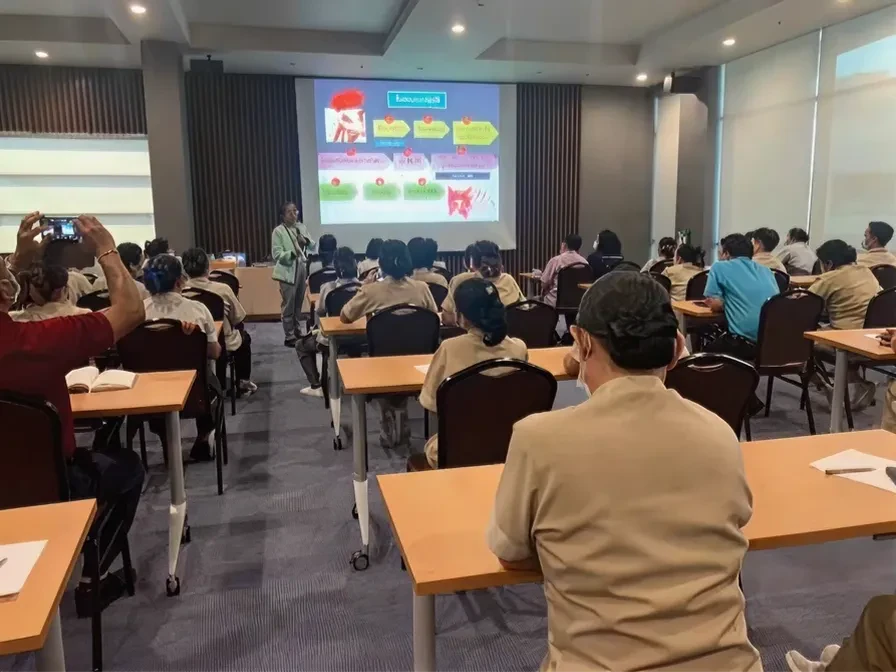
The Company sets a target for average training hours of not less than 15 hours per person per year to support employees in developing the knowledge, understanding, and skills required for safe work. Training topics cover accident prevention, use of personal protective equipment, infection control, chemical handling, fire safety, evacuation, and basic first aid.
Beyond topic-based training, the Company aims to build a safety culture in which employees recognize that safety is a shared responsibility of everyone. This helps ensure that safety measures are not only operational requirements, but also everyday behaviors practiced by employees at all levels.

- For the hospital business, emergency preparedness is critically important because an emergency may affect patients, employees, service users, building systems, and healthcare service continuity at the same time. The Company therefore places importance on emergency drills, fire response, evacuation, first aid, and coordination among relevant departments.
- In 2025, Sikarin Hospital Bangkok conducted a fire emergency drill in collaboration with Phra Khanong Fire Station. The drill strengthened understanding of fire equipment use, rescue procedures, patient transfer to safe areas, and evacuation routes suitable for the hospital context. It also helped employees understand their roles during emergency situations and improved readiness to respond to actual incidents.

- Infection prevention and control is a key safety issue in the hospital business because medical personnel and relevant parties may be exposed to infectious agents, sharps, and medical waste during daily operations.
- The Company establishes infection control practices, promotes the use of personal protective equipment, manages medical waste safely, and communicates relevant practices to employees on an ongoing basis. These measures help reduce risks to workers, service users, and stakeholders in service areas.

- The Company also places importance on the safety of contractors, suppliers, and external personnel working within hospital premises. It communicates safety requirements, supervises contractor work, and includes safety conditions in relevant procurement processes or contracts where appropriate.
- This approach helps ensure that work performed by external parties is aligned with the Company’s safety standards and reduces risks arising from activities within hospital premises.
Commitment to a Safe and Sustainable Future
Sikarin Public Company Limited is committed to advancing its safety and occupational health systems by integrating technology into safety management, such as using AI and IoT to monitor safety data, developing safety reporting platforms, and leveraging telemedicine and robotic patient care systems.
These efforts aim to ensure that employees, patients, and visitors are cared for in a safe environment that meets the highest
Our Projects
Sikarin's sustainability program focuses on ESG issues, financial performance, community health, environmental impact reduction, and employee welfare promotion.